




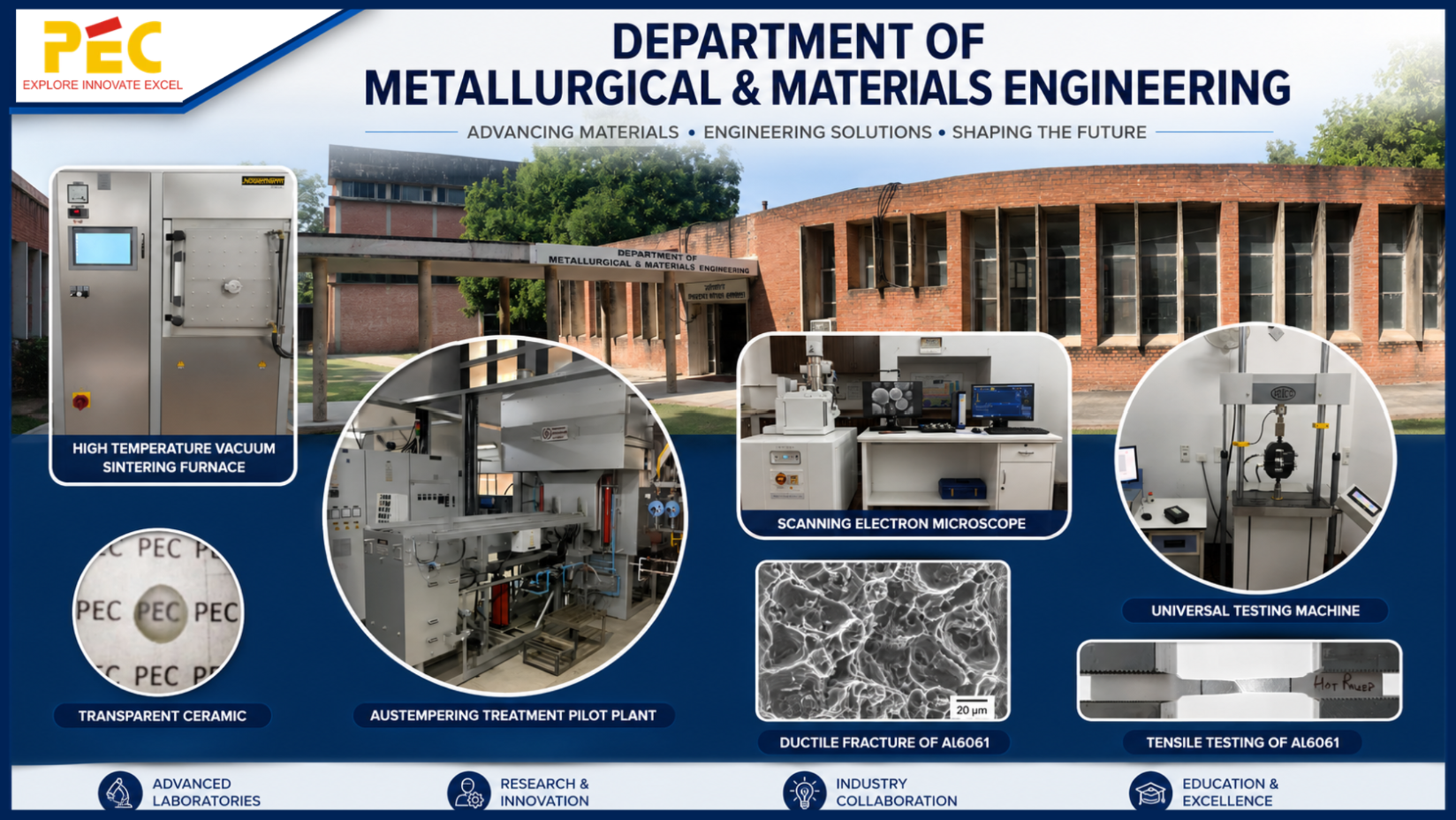
Established in 1963, the Department of Metallurgical & Materials Engineering (formerly the Department of Metallurgical Engineering) at Punjab Engineering College (Deemed to be University), Chandigarh, has evolved into a leading centre for education, research, and innovation in materials engineering. For over six decades, the department has been committed to producing skilled engineers, advancing cutting-edge research, and strengthening academia–industry collaboration.
The department offers B.Tech. in Metallurgical & Materials Engineering (annual intake: 60 students), M.Tech. in Industrial Materials and Metallurgy, and Ph.D. programmes. Its curriculum is designed to provide a strong foundation in the science and engineering of metallic alloys, ceramics, polymers, composites, and emerging materials, while integrating modern computational and sustainable materials technologies.
A distinctive feature of the department is its strong emphasis on industry engagement. Students gain valuable practical exposure through a semester-long industrial internship and the Industry–Institute Interaction Week conducted every semester. These initiatives bridge classroom learning with industrial practice and prepare graduates to meet the evolving needs of modern manufacturing and materials industries.
The department actively supports industry through consultancy services in areas including alloy development, composite development, powder metallurgy and ceramics, failure analysis, heat treatment optimisation, materials characterization, non-destructive testing, corrosion studies, and battery recycling technologies, helping industries solve critical engineering problems with scientific and technological expertise.
Research is a major strength of the department. Faculty members and research scholars are engaged in government-funded and industry-sponsored projects spanning advanced materials development, austempered ductile iron, advanced high-strength steels, structure–property relationships, lightweight alloys, nanomaterials, biomaterials, high-temperature materials, corrosion engineering, energy storage materials, sustainable recycling technologies, additive manufacturing, and computational materials engineering.
The department is equipped with modern teaching and research laboratories that support high-quality education, advanced experimentation, and interdisciplinary research. Supported by highly qualified and experienced faculty, it provides an environment that fosters innovation, scientific inquiry, and professional excellence.
Graduates of the department have established distinguished careers in leading industries, research organizations, academic institutions, and multinational companies across India and around the world. The department's strong alumni network continues to contribute to its growth through mentorship, industry collaboration, and professional engagement.
With a legacy of excellence and a vision for the future, the Department of Metallurgical & Materials Engineering continues to advance sustainable materials technologies, innovative research, and industry-relevant education to address the challenges of the twenty-first century.